Building has always been a complex task, and in the current context it has become even more challenging. The scarcity of available land, the shortage of skilled labour, rising construction costs and the uncertainty caused by geopolitical tensions have turned new-build initiatives into increasingly demanding and ambitious undertakings. In this scenario, architecture must address a fundamental question: should we continue to build new projects whenever a need arises, or is it time to take a closer look at our existing built heritage?
The regeneration of buildings is a responsible, sustainable and deeply contemporary strategy. It requires high technical expertise, an understanding of urban sensitivity and the ability to identify hidden value. Many buildings that have lost their original purpose still retain their structure, presence, accessibility, construction quality and potential to once again serve the city.
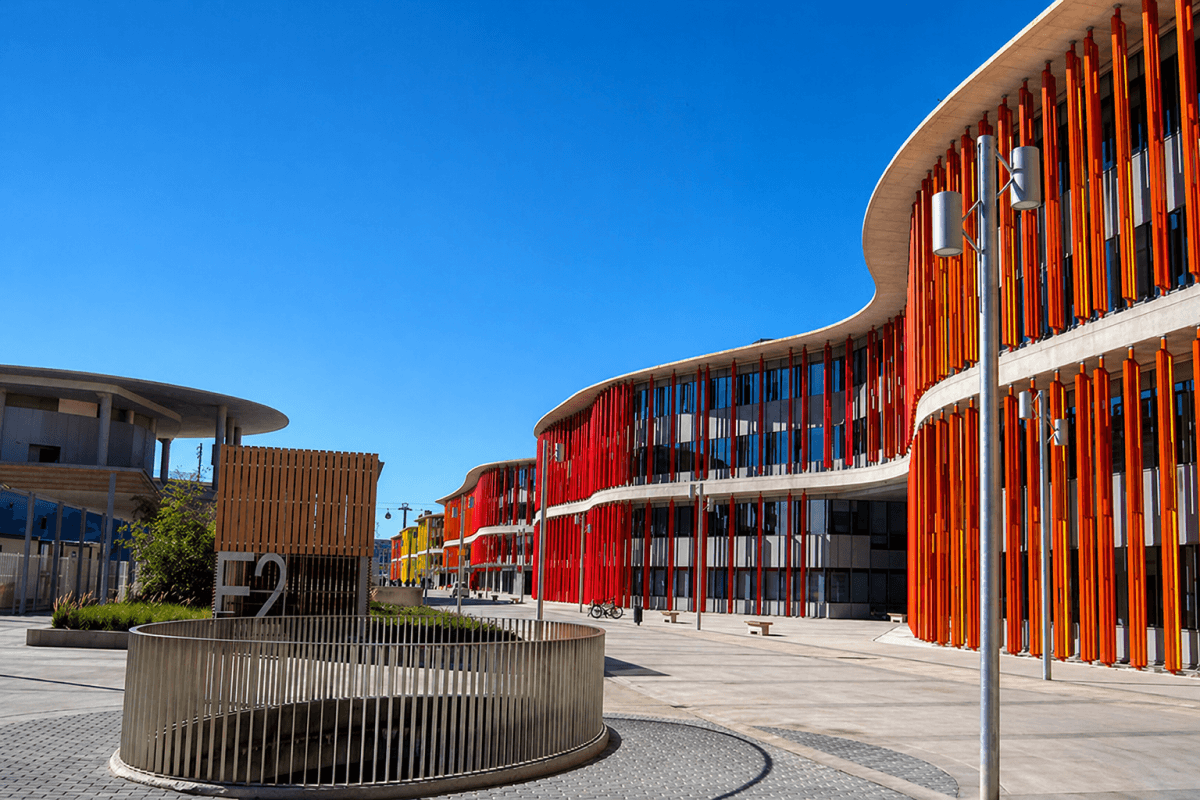
This is the opportunity that The Power Education is embracing in Zaragoza to develop its first in-person teaching campus in Spain, located in the Ebro IV Building within the Expo Water 2008 site. Almar Consulting is providing 360º management services and architectural consultancy for the project, with the aim of fully regenerating and adapting an existing building for new university educational uses.
Zaragoza is a strategic city, well connected, with a balanced scale, a strong service offering and a privileged location between some of the country’s main economic hubs. Added to this is the unique value of the Expo site, legacy of the 2008 International Exhibition held under the theme “Water and Sustainable Development”, which left behind a high-quality urban and architectural infrastructure. Buildings, public spaces, routes and services originally designed for an international event can continue generating value today when supported by stable and contemporary uses.
Architecture plays a decisive role in ensuring that this transformation is not merely an occupation, but a true second life. It is about understanding the building, recognising its strengths, accepting its limitations and transforming them into a functional, welcoming, attractive and valuable experience.
There are recent and remarkable examples that embody this approach. The Tate Modern in London, inaugurated in 2000 following the transformation of the former Bankside Power Station by Herzog & de Meuron, turned a power station into a European cultural icon. Zeitz MOCAA in Cape Town opened in 2017 in a former grain silo transformed by Heatherwick Studio. In the educational field, the Harald Herlin Learning Centre at Aalto University in Espoo (Finland) transformed Alvar Aalto’s former 1970 library into a contemporary learning centre in 2016 through the intervention of NRT Architects and JKMM Architects.
All these examples share the same spirit that Almar Consulting seeks to bring to The Power Education project: good architecture is not always about building anew or replacing what already exists; sometimes, it can provide a second life.
This same philosophy is present in the proposal to transform the former Buenavista Complex in Oviedo, originally conceived as a shopping centre and currently unused, into a campus for Universidad Alfonso X el Sabio. The project will recover an abandoned asset and transform it into a knowledge hub capable of contributing to the revitalisation of the Buenavista neighbourhood, an area that has lost activity following the disappearance of Real Oviedo’s former football stadium and the Central Hospital of Asturias. Transforming a shopping centre into a university campus is not simply a change of signage. It involves rethinking programmes, functionality, circulation, lighting, acoustics, accessibility, comfort, identity, regulations and user experience. Where consumption once dominated, a new logic based on teaching, research, community and collaboration can now emerge.
The approach behind The Power projects in Zaragoza and UAX in Oviedo reflects a commitment to architecture as a precise tool for managing complexity, recovering dormant assets and generating social value. Every recovered building enhances a city, brings activity back to a neighbourhood, attracts services, creates employment and strengthens the identity of a place.
Because when architecture enables an unused building to become necessary again, it restores memory, investment, activity, beauty and future. This is where Almar Consulting’s value lies within architecture: not only in creating new buildings, but in revealing the hidden potential of those that cities should not yet consider lost.
📰 News article link